Monday, October 3, 2016

Abstract Comics: The Anthology... + Narrativeishness

I came across this book while doing research in the library. I was looking at the idea of narrative abstractions. That is the narrative arc of a story (beginning middle end) being present in abstractions. and i kept getting conflating the idea that narrative and story were the same thing, or that narrative had to imply that there was representational imagery. 

But then i remembered that Stan Brakhage has narrative in his pieces. and so then i began to wonder how that would translate over into images, seeing as its easier to compose narrative with constant movement rather than still images. and so i was like what has narrative and images… COMICS!!

Low and behold theres an abstract comics: the anthology book. This book looks and tries to answer the question of how comics can be abstract.

This book gathered together a list of comic artists who have been toying with the idea of comics that told “stories” but whose panels have little to no representational imagery. Basically what they did was reduce comics to the most basic of their elements - Panel Grid, Brushstrokes, colors. and what this did was highlight the underlying formal mechanism that all comics have (leading the eyes from page to page, sequence of page layouts etc.)

Reading through this book and looking at all these images helped me to move forward with my research.
It’s clear to me now that abstraction and narrative can coexist together because Narrative doesn’t imply representational identifiable realities or objects, its about the passage of time and change over time, i.e for something to have narrative it has to change over time. 

It’s getting me thinking about:
  • What is character?
  • What is a story?
There has to be a flow involved (Beginning, middle, end) (conflict, action, resolution)

But so I’m thinking about these things that I’m creating as if they were alive i.e. they’ve got their own history, they have a story to them (SONDER)

Representation - has history, it has identifiable language, there’s semiotics involved.
Then i thought, can abstractions (in the sense of complete non representational imagery, no identifiable traits in reality) have semiotics? have representation?

I think in a sense, yes they can. If you strip photography of representation, thats a very political and pointed action. There’s a very definitive reasoning behind that. When you strip photography of representation you’re left with thinking about surface, material, physicality, form, PROCESS. etc. 
(this is as far as I’ve gotten to thinking about this because i haven’t really developed a language for talking about it.) 
No photo politics if you will. (why i make what i make vs why i don’t make what i make.)

But i think its important to develop a language if you’re working in abstraction. what i mean by that is that lets say for example you take a picture of a coffee cup, that already has a history, its easy to talk about because it already has an identifiable language behind it (a history) 
But with abstraction you have to develop your own language to talk about what this is, and why it matters. 
PROCESS i think might be a good place to start because that implies narrative (steps to take to achieve an action or a result) Process has a history, materials have a history behind them.

I think one thing moving forward is i have to look and see:
  • What’s consistent in my work?
  • What’s changing?
  • What keeps me going?
Also i think I might be taking abstraction to literally. So i think i have to be more abstract in thinking about abstraction which means possibly being a little more literal when it comes to creating abstractions. I dunno something to think about i suppose.

But yeah this abstract comics book, check it out if you get the chance its really neat!

heres a link to the book:


So yeah abstraction can have reference, narrative, etc. even though they’re a departure from reality. Thats kind of awesome!


…. afterthought: i mean there are varying degrees of abstraction. if you’re talking about formal compositions from figurative sources, that implies reference of an object in reality. and then theres the complete departure from reality, non representational abstractions that have no derivation from reality based objects.


Follow an 8-year-old around all day


Tibyan Sanoh is a photographer from Manchester, England. In this series, titled Kids Of the Estate, she photographs a young boy named Daniel. This series is particularly interesting to me because it features a child. Personally, I am very intimidated by children--especially trying to photograph a stranger's child. Despite my anxieties about this, I feel there's a lot to learn from children. Perhaps more than adults sometimes. I think that even with shy children, they can reveal a lot about themselves that an adult may have trouble with. 
I think this series strikes me, being that I used to take preschool portraits for a part-time job. I took well over a thousand photos of different children, but I never really got to know any of them. Our time was bracketed around 3-5 minutes per child. I am a little envious of Sanoh. It really seems like she got to know Daniel during this day that she spent with him. I think it's interesting to observe how a child acts around a camera compared to how an adult reacts.

art work with textiles and considering relationships- textile arts center


I've been thinking a lot about being drawn to fabric and what options there could be for me. Starting from the top I started looking at ideas of fabrics that we have come into contact with since we came into this world. quilts, clothing, decorations, towels, rugs, shoes, furniture, etc.  Considering mostly the relationships that we have with these different materials and how they could possibly be changed? I'm not exactly sure where I would even like to go with this


After further doing research I found this link that had a lot of great information:

http://textileartscenter.com/blog/bric-contemporary-artists-working-in-textiles/

some of the information may have helped me figure out WHY I have such an intimiate experience

with cloth materials. Julia Elsas, Untitled, 2011

This particular piece of art struck me. Maybe mostly do to the color, but also interesting in her way of reshaping and re-thinking women's undergarment and the experience that we have with them. I'm very interested to continue searching for artwork and viewpoints on using cloth to create an experience that not only relives your old experience with the fabric, but ties in new ones.

"Humans are the only species so entirely dependent upon, and deeply intertwined, with cloth. Our relationship with this material begins moments after birth, and one might even propose that cognizance of cloth is simultaneous with that of our own skin. Consciously or unconsciously, textiles play a role in our daily lives, on a spectrum equivalent to the diversity of our human experience."

Jim Goldberg

I recently heard about this artist, Jim Goldberg, because Alec Soth posted about his new book Raised By Wolves Bootleg  

Jim Goldberg is a storyteller, he began experimenting with text on photos with a series called Rich and Poor where he juxtaposed people living in welfare motels with the upper class in their homes, brining into question American myths about class, power, and happiness.
 

In the original book, Raised by Wolves he documents the lives of teenagers in San Fransisco and LA who ran away from home and created a book and exhibition including his photographs, snapshots, home video stills, drawings, diary entries, and sculptures. The version he just put out is a xerox copy of the original but also includes some new additions. 

https://vimeo.com/jimgoldberg/raisedbywolves


He also made a book called Open See where he tells the story of refugees, immigrants, and trafficked individuals journeying from their countries of origin to their new homes in Europe. Open See stays within Goldberg’s multi-faceted and multimedia practice by using diverse formats to create a thickly interwoven, expressionistic narrative from many points of view.


Currently Goldberg is working on a project called Candy explores American notions of aspiration and betrayal by using archived material and home videos from his childhood in New Haven as well as new photographs of its current residents and landscape. 


"I have the great privilege of being both witness and storyteller. Intimacy  trust, and intuition guide my work" -Jim Goldberg 

Binh Danh

Binh Danh was introduced to me last semester in my alternative processes class and I thought it was so beautiful and brilliant. He created his own technique, referred to as the chlorophyll process, in which he uses positive images and lets them expose over several days. If the resulting image isn't cast in resin it will not last, so it can also be something made to be impermanent, if it lends to the idea. 
Most of Danh's work is focused on the Vietnam War, a kind of way of creating an imaginary life he could have had if he had grown up in Vietnam (moved to the United States when he was two). 
From his series Immortality, The Remnants of the Vietnam and American War


"This process deals with the idea of elemental transmigration: the decomposition and composition of matter into other forms. The images of war are part of the leaves, and live inside and outside of them. The leaves express the continuum of war. They contain the residue of the Vietnam War: bombs, blood, sweat, tears, and metals. The dead have been incorporated into the landscape of Vietnam during the cycles of birth, life, and death; through the recycling and transformation of materials, and the creation of new materials. As matter is neither created nor destroyed, but only transformed, the remnants of the Vietnam and American War live on forever in the Vietnamese landscape." - Binh Danh
I love all the different ways photography can be used, that it isn't strictly an image on paper - it can become an object,  a doorway, anything you want if you can find a way to execute it. I remember reading an interview where he said the process fails to produce a usable image nearly 80% of the time, and reminds me to try to remain patient and not view something working out differently than expected as a failure.

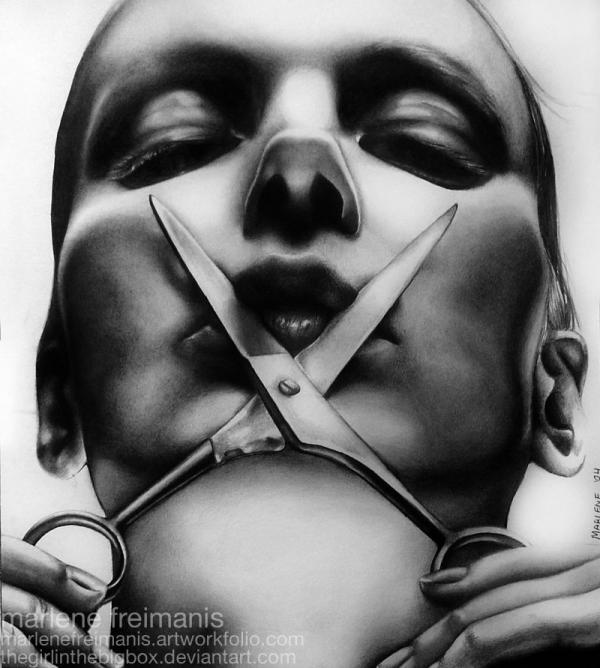
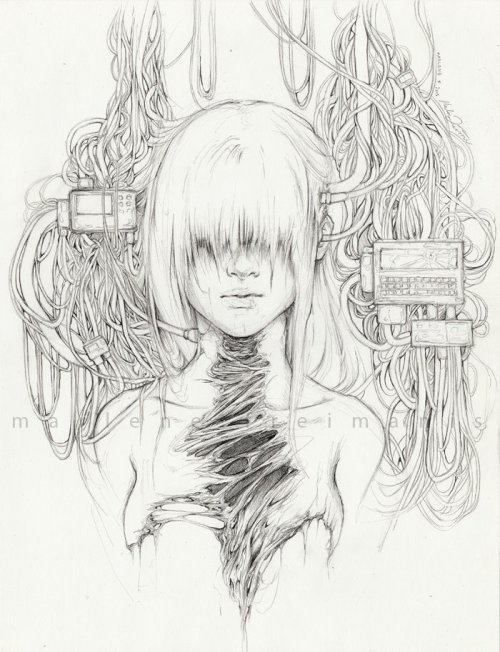
Marlene Freimanis

Since I've been itching to "go back to my roots" lately as far as including blood/organs/limbs/monsters/fearsandanxietieswhathaveyou, I guess I should probably mention the artist who literally inspired me to take drawing/painting/art overall seriously.

Marlene Freimanis  is an artist who focuses on drawing and painting, who is known for her gory portraits, as well as her insanely colorful rainbow works, which can sometimes be considered "fan art." I remembered a friend of mine showed me her work on DeviantArt (yeah I was way into DeviantArt at the time) and I IMMEDIATELY fell in love with her work. I dunno what it was, but something about monsters really resonated with me, and felt right. On the other hand, her more colorful, rainbow works inspired me to try more "cartoony" things with my work. So yeah, here's the person responsible for my love for horror in art.


Sunday, October 2, 2016

Pura Vida

Pura Vida is an artist book written by Tasja Keetman. I was sifting through the photo section at the library when I found this book.When I opened it, all I saw was bunch of words that looked like the artist had written whole pages and then took out all the important bits. I was still confused though as to why this was in the photography section. It wasn't until my fourth look at the book that I figured it it out. The artist had made this book using an accordion fold and placed the images inside the folds. This forces the viewer to peek inside the crevices to see the images. I don't know why it took my dumb ass so long to figure it out but I love it. Text whose, she is talking about the many physical and emotional scars she has had to go through in her life. Personally, I really related to a lot of the things she was saying. For example:
  • "There were some dark times in my life, but it takes darkness so one can love the light"
  • "After all I had lived through up until then to was just like oh, another thing, ah well" 
  • "You are invited to celebrate the light side of life, celebrate, the dark side of life, one is not without the other" 
  • "It seemed that this something extra had my back, was watching feeling me"
The title of the in english means "Pure Life." I think the above quotes I selected answer why she decided to title this book that. It's something to think about.