Monday, November 28, 2016

Letha Wilson


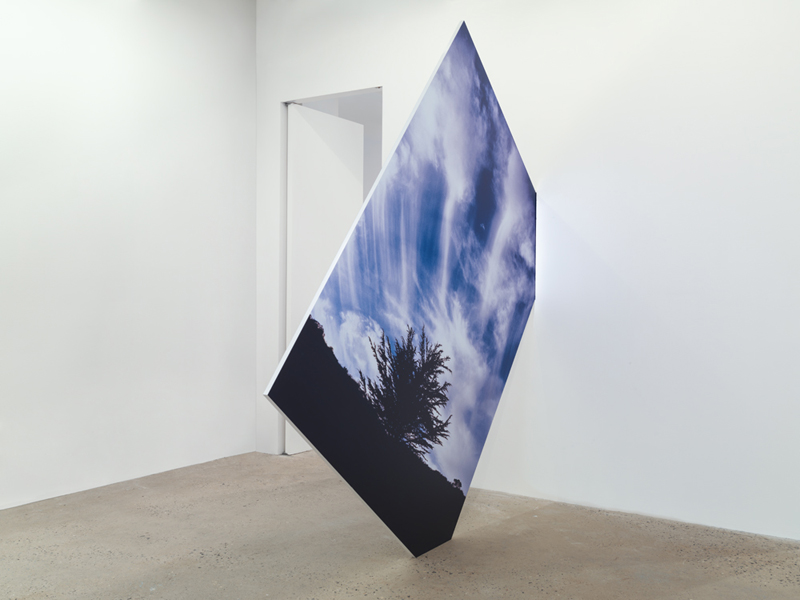
A while back I got an e-mail from Shane that just read "Also, Letha Wilson" and a link to her website. She utilizes different mediums and interacts with the space in a way that I would really like to explore in future work. Much of her work is a conversation between the natural and architectural world, photograph and scultpure, a new take on the "landscape photograph" - and her installations always feeling a bit intrepid.
Wilson was featured among many other artists I admire/am inspired by in What is a Photograph? curated by Carol Squiers - including Mariah Robertson, Alison Rossiter, Marco Breuer, Matthew Brandt, etc. These artists all push the notion of what photography can be, making photographs into objects, taking up space - experimenting and reimagining. Wilson, among these others, inspire me to continue researching and learning new ideas and techniques. Photography in it's many forms can be an adventure - a journey into memory, an exploration of new worlds -  and that is how I hope to continue my work as well.

Shirin Neshat's "Turbulent"

Shirin Neshat is an Iranian film/videomaker, who also does work with photography. Her work is known to bring together contrasting subjects, the contrast between Islam and the Western world being her most talked about one.

I've known about her for a little while now, but recently I took the time to re-watch Turbulent (1998).
It got me thinking about the concept of showcasing such duality in a work, and it especially made me think of how I could further push that concept in my own video pieces - in my case, I guess the duality of reality and abstraction. Aside from that, Turbulent is such a strong piece and so so powerful in its ways of of music and emotion to represent gender and it's complexity.

https://www.youtube.com/watch?v=f2DNMG2s_O0

Sanja Marusic

Ok, I normally wouldn't gravitate towards photographers with a tumbler aesthetic but i'm going to make an exception for this one. I was looking at GUP Magazine's blog and I stumbled upon this lovely woman names Sanja Marusic. There's not much information about her work flow or her concepts online but I do view her as a very inspirational woman. Just two years after undergrad she got signed to a photography agency and has her own gallery. GOALS! Her work, as a whole, is beautiful. I did find an interview with her online where she talked about not liking surrealist work even though most of her work has some form of surrealist element to it. I can relate to that with me not wanting to have feminist undertones in my work but somehow always making them. The heart wants what the heart wants I suppose. My favorite series I found by her is titled Moonscape Island. In this series she focuses more on the landscapes her models are interacting with than the models themselves. Its like the models are the props and the landscapes are the main subject. She creates this world that seems oddly seducing to the viewer. This could just be her color pallet or her use of lighting, I'm not entirely sure. However, I do know that I will be revisiting her work as inspiration for later projects.

http://www.sanjamarusic.nl


Tuesday, November 22, 2016

Analyzing vs Taking A Stance

During the Daniel Shae lecture I found myself not quite satisfied with a lot of his answers. I felt like I might of been in the minority in that opinion based on a few different talks about it I participated in afterwards. I actually really liked his work, and found him to be competent and expressive about what drove him to make certain work. I felt like since it was so close to the election I may have been viewing it through a very augmented lens. He mentioned his work was political in nature and I suppose I expected more along those lines, and I believe his completed piece would have fulfilled my expectations for politically motivated art. The only criticism I had on his work was the cruising/construction site portion. I appreciated his honesty in admitting he just thought it was funny. It felt like that needed his personal viewpoint on the issue to carry any meaning.

What struck me was his analytical stance in his art. That is something I really appreciate normally, and strive to do in my own work and life in general. But for some reason on that day, that really bothered me. And I really think it had to do with the election and the headspace everyone was in. It was through no fault of his own that I found the method of observing and not taking a stance on issues infuriating. As I do whenever I feel something too strongly, I attempted to check myself first for the answer. I'm quite positive what bothered me about it was that I often don't like taking strong stances on things. I prefer to keep messages remote so anyone could potentially identify with them. I'm the type that sleeps on emotional actions to see if they are still there in the morning. I think this lack of engagement, by me and many others, is the essence of what's been wrong with how we interact with each other. This provided me with the urge to include more of a difinitive meaning to my work, words, and actions. I will always continue to analyze things from as many viewpoints as possible. But it's become clear to me we need more action than observation lately. So I'm going to try to incorporate that feeling into my future endeavors.

46.5°N by Anastasiia Chorna


I came across Anastasiia Chorna in an article and I was very intrigued by the title. Chorna says that 46.5°N is the latitude of two cities that she has deep admiration for: Odessa, Ukraine and Lausanne, Switzerland. She set out to capture the obvious differences and similarities between the two towns. This set of work stuck out to me because I have never been to either of these places, but I am drawn to the images because of the thought and obvious passion behind the work. It reminded me, even though I often question if people will be interested in my work at all, that the viewer can be compelled by the images more the the overall idea of the work.
I think that this series is really interesting because it has a mixture of black and white photos and color. It gives the work a sense of time passing. Even though you can't tell which photo is from which town, there is a fluidity to the work. I am interested in this idea of comparing different places that you feel strongly about. I've often thought about going to Petersburg in thought of sparking connection with it's neighboring city that's my home town (Richmond).


Polaroid Land Cameras


Natalie and I have recently been playing around with a polaroid land camera in the studio.  It's been a lot of fun to try and trouble shoot different issues that have arisen while we've been working.  For example, trying not to pull multiple sheets of film out of the camera after exposing a shot, resulting in ruining several pieces of film.  


My favorite part about this process is after you wait the 2 minutes and finally get to expose the shot, the opposite negative image that appears because of the leftover chemicals is so cool to see.  It ends up drying and disappearing, but while it lasts it leaves a very eerie image. In the one pictured below my face was completely gone and had no detail but the detail in my hair was very sharp.  It's a really fun process to play around with and I am interested in buying my own land camera so I can play around with it more.

Rest and Installation

Recently i've been trying to scale back the crazy as it were; or rather the chaos of my images. Trying to focus on the idea of still having these crazy moments of overwhelming imagery, but mixing those moments with calm sort of "rest" images if you will. That way the viewer can have varying levels of emotional reaction to an installation, and things might seem a little more clear, or understandable.

I've looked at the installations of James Hoff, and Wolfgang Tillmans a lot the past couple of days and i've noticed that they confuse you with imagery, but they install it in a way where you are able to follow it, flow with it, and then ultimately come to an understanding of the point the artist is trying to make, and i think if i really push the idea of installation in my pieces it will help with the understanding of such abstract forms.

Going back to that idea of rest, i keep thinking a lot about minimalist sculptors and painters, and the idea of simple forms just being placed in certain areas for the eyes to take a break and hop back to reality for a second before continuing. Kind of like how you see in movies when someone says "i need some air" I dunno i'm still exploring this, but i think my next step is to try and scale it back while also pushing it forward (if that makes any sense.) I think i have to come to terms with the idea of representation first. and maybe more thought to composition might help.